Our care and research:
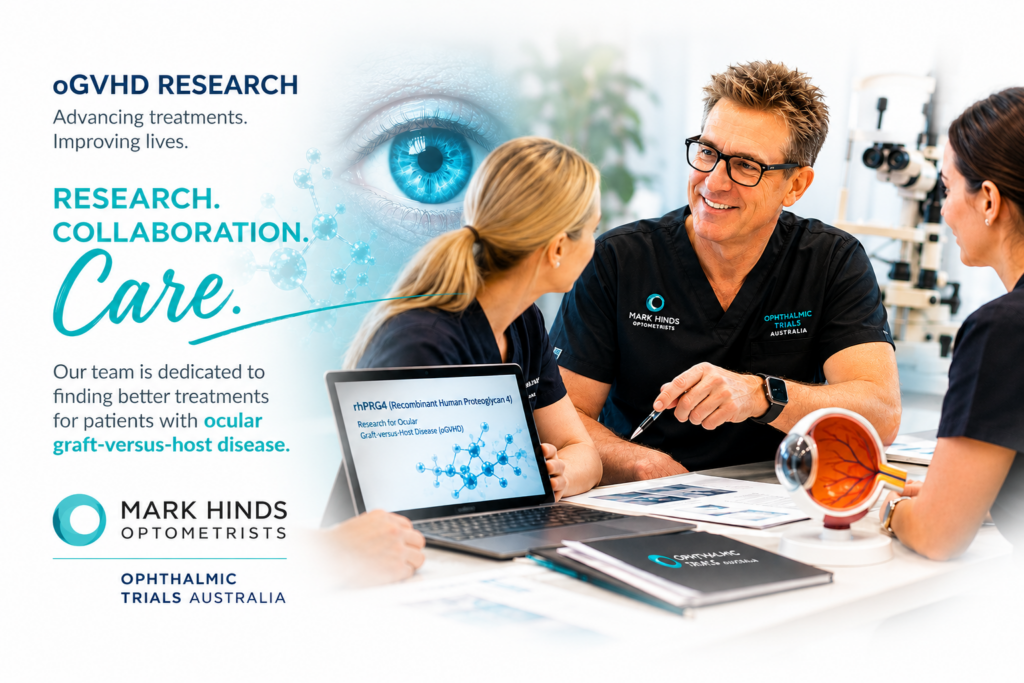
At Mark Hinds Optometrists and Ophthalmic Trials Australia (OTA), our team is committed to improving the lives of patients living with severe ocular surface disease through research, innovation, and compassionate clinical care.
One area of increasing focus is ocular graft-versus-host disease (oGVHD) — a potentially debilitating complication that can occur following bone marrow or stem cell transplantation for cancer treatment.
For many patients, surviving cancer is only part of the journey. Chronic oGVHD can leave patients with severe dry eye disease, ocular pain, light sensitivity, blurred vision, inflammation, and damage to the surface of the eye that significantly affects quality of life.
Our team is proud to be actively involved in international research efforts aimed at finding better therapies for this challenging condition.
What is Ocular Graft-versus-Host Disease?
Ocular graft-versus-host disease occurs when transplanted donor immune cells attack healthy tissues of the recipient, including the delicate tissues of the eye and tear film system.
Patients may experience:
- Severe dryness and burning
- Fluctuating or blurred vision
- Light sensitivity
- Chronic inflammation
- Eye pain and discomfort
- Damage to the corneal surface
- Reduced tear production
Managing oGVHD is often complex and may require advanced dry eye therapies, anti-inflammatory treatments, specialty contact lenses such as scleral lenses, and emerging biologic therapies.
At Mark Hinds Optometrists, we have a dedicated focus on advanced ocular surface disease management and specialty contact lens care for complex corneal disease.
International Research Collaboration
Our Brisbane-based research team at Ophthalmic Trials Australia has been collaborating with leading international researchers and institutions investigating new treatments for oGVHD.
One of these projects includes:
A Phase I Prospective Open-Label Study Assessing the Safety & Efficacy of rhPRG4 (450 µg/mL Recombinant Human Proteoglycan 4) for the Treatment of Ocular Graft-Versus-Host Disease
This collaborative research includes investigators and scientists from Australia and the United States working together to explore the potential role of rhPRG4 (recombinant human Proteoglycan 4 / Lubricin) in improving ocular surface health and patient comfort.
Collaborating Authors & Institutions
- Mark Hinds — Ophthalmic Trials Australia, Brisbane, Australia
- Tracey Hinds — Ophthalmic Trials Australia
- Axel Hinds — Ophthalmic Trials Australia
- Georgia Duhig — Ophthalmic Trials Australia
- Brendan Cronin — Ophthalmic Trials Australia
- Ben Sullivan — Lµbris BioPharma
- Richard Chang — Lµbris BioPharma
- Edward Truitt III — Lµbris BioPharma
- Harry Barnett — Lµbris BioPharma
- Victor Perez — University of Miami
- Tannin Schmidt — UConn Health
- Gregory Jay — Brown University
- David Sullivan — Tear Film & Ocular Surface Society (TFOS)
- Stephanie Watson — The University of Sydney
Looking Ahead — Phase 2 Clinical Trial in 2026
Building on earlier safety and efficacy research, Ophthalmic Trials Australia is proud to be involved in ongoing clinical trial efforts in 2026 focused on improving treatment options for patients with oGVHD.
The goal of this work is simple but important:
To help find therapies that reduce pain, improve comfort, protect the ocular surface, and improve quality of life for patients living with ocular graft-versus-host disease.
Clinical trials are essential for advancing eye care and bringing new therapies to patients who urgently need better treatment options.
Our team remains deeply committed to conducting ethical, patient-focused ophthalmic research while helping participants access cutting-edge investigational therapies under carefully monitored clinical trial protocols.
Supporting Patients Beyond Research
Research is only one part of what we do.
At Mark Hinds Optometrists, we also provide ongoing clinical care for patients living with severe dry eye disease and complex ocular surface conditions, including:
- Advanced dry eye management
- Scleral contact lenses
- Ocular surface disease assessment
- Corneal imaging and monitoring
- Collaborative care with ophthalmologists and oncology teams
We understand that for many patients affected by oGVHD, the ocular symptoms can be life-changing. Our mission is to combine evidence-based clinical care with world-class research to help improve patient outcomes now and into the future.
Interested in Learning More?
To learn more about our clinical research program or current ophthalmic clinical trials: