Myopia Control Today — Protecting Vision for the Future
At Mark Hinds Optometrists
Are you or your child becoming increasingly short-sighted?
Myopia (short-sightedness) is now one of the fastest growing eye health concerns worldwide. While glasses and contact lenses can correct blurred vision, modern eye care is now focused on something even more important — slowing the progression of myopia and protecting long-term eye health.
At Mark Hinds Optometrists, our dedicated Myopia Management Clinic combines advanced technology, evidence-based treatment, and personalised care to help reduce the progression of myopia in children and young adults.
Why Is Myopia Becoming So Common?

The prevalence of myopia is increasing rapidly across the globe. In some parts of Asia, rates of myopia in school-aged children now exceed 80%, and rates continue to rise in Australia and internationally.
Research suggests that myopia development is influenced by both:
- Genetics
- Environmental factors
Modern lifestyles now expose children to:
- Increased screen time
- Greater near work demands
- Reduced outdoor activity
- Less exposure to natural light
These factors appear to influence how the eye grows during childhood and adolescence.
Why Does Myopia Matter?
Myopia is not simply an inconvenience requiring glasses.
As the eye becomes longer (axial elongation), the lifetime risk of serious eye disease increases significantly.
Higher levels of myopia are associated with:
- Retinal detachment
- Myopic macular degeneration
- Glaucoma
- Cataract
- Myopic retinal disease
- Earlier vision impairment later in life
This is why modern myopia management focuses not only on clearer vision today — but healthier eyes in the future.
Can Myopia Be Slowed?
Yes.
Current research shows that several evidence-based treatments can significantly slow myopia progression in many children.
The earlier treatment begins, the greater the potential benefit.
At Mark Hinds Optometrists, treatment options may include:
- Orthokeratology (Ortho-K)
- Low-dose atropine therapy
- Myopia control spectacle lenses
- Soft contact lenses designed for myopia management
- Lifestyle and outdoor activity recommendations
- Ongoing axial length monitoring
Every child has a unique risk profile, which is why personalised care is essential.
Advanced Technology Matters
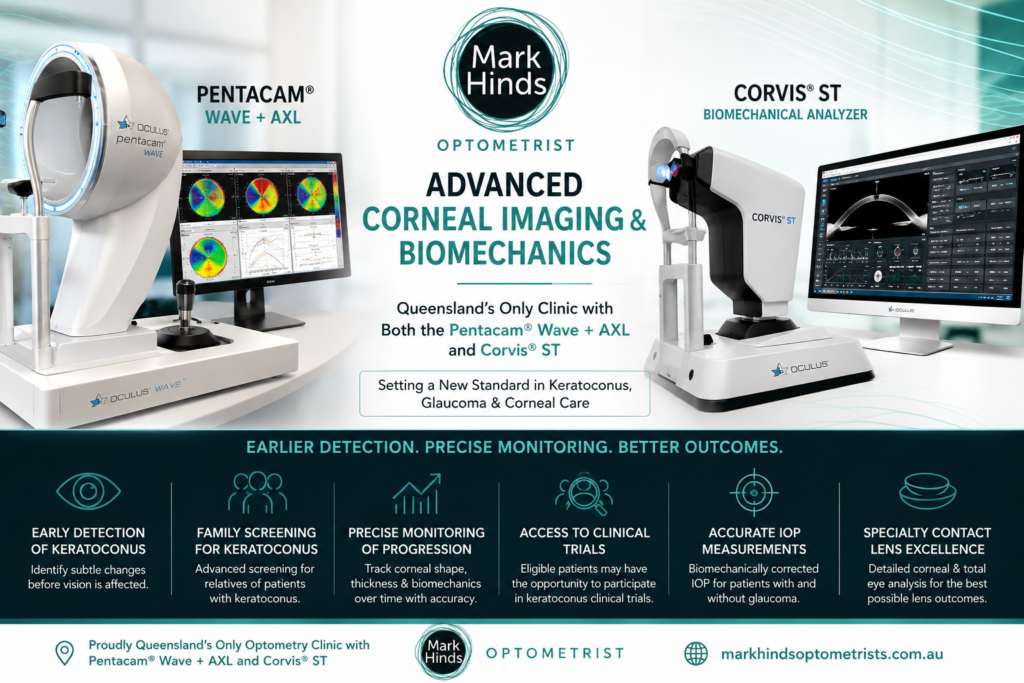
We believe precise monitoring is critical in modern myopia care.
Our clinic uses advanced imaging and measurement technology including:
- Pentacam Wave + AXL
- OCT biometry and axial length monitoring
- Corneal topography and tomography
- Advanced contact lens fitting technology
Importantly, we monitor not only changes in glasses prescription, but also axial length — the underlying structural change responsible for progressive myopia.
This allows us to track progression with exceptional precision and tailor treatment accordingly.
Orthokeratology (Ortho-K)

Orthokeratology (Ortho-K) remains one of the most effective and well-researched non-surgical options for myopia management.
These custom-designed overnight lenses gently reshape the cornea during sleep, allowing:
- Clear daytime vision without glasses
- Reduction in peripheral hyperopic defocus
- Slower progression of myopia in many patients
Our clinic has extensive experience fitting Ortho-K lenses since 2003, with hundreds of successful fits across children, teenagers, and adults.
The Importance of Outdoor Activity
Emerging research continues to support the protective role of outdoor activity and natural light exposure in childhood eye development.
Children who spend more time outdoors may have a lower risk of developing progressive myopia.
As part of a comprehensive myopia management plan, we discuss:
- Healthy screen habits
- Visual posture
- Working distances
- Outdoor activity recommendations
- Balanced visual environments
Personalised Myopia Management
At Mark Hinds Optometrists, our goal is simple:
To help protect your child’s long-term vision and eye health.
Our team combines:
- Advanced technology
- Evidence-based treatment
- Specialty contact lens expertise
- Ongoing monitoring
- Individualised care plans
We understand that every patient is different, and successful myopia management requires a tailored approach.
To learn more about myopia control or to book a consultation with our experienced team, contact:
(07) 3358 6566
Or visit:
www.markhindsoptometrists.com.au
References
1. Vitale S, Sperduto RD, Ferris FL 3rd. Increased prevalence of myopia in the United States between 1971-1972 and 1999-2004. Arch Ophthalmol. 2009;127(12):1632-9.
2. Bloom RI, Friedman IB, Chuck RS. Increasing rates of myopia: the long view. Curr Opin Ophthalmol. 2010 Jul;21(4):247-8.
3. Xiang F, He M, Morgan IG. The impact of parental myopia on myopia in Chinese children: population-based evidence. Optom Vis Sci. 2012 Oct;89(10):1487-96.
4. Morgan IG, Ohno-Matsui K, Saw SM. Myopia. Lancet. 2012 May 5;379(9827):1739-48.
5. Yang Z, Lan W, Ge J, et al. The effectiveness of progressive addition lenses on the progression of myopia in Chinese children. Ophthalmic Physiol Opt. 2009 Jan;29(1):41-8.
6. Walline JJ, Lindsley K, Vedula SS, et al. Interventions to slow progression of myopia in children.Cochrane Database Syst Rev. 2011 Dec 7;(12):CD004916.
7. Tan DT, Lam DS, Chua WH, et al and the Asian Pirenzepine Study Group. One-year multicenter, double-masked, placebo-controlled, parallel safety and efficacy study of 2% pirenzepine ophthalmic gel in children with myopia. Ophthalmology. 2005 Jan;112(1):84-91.
8. Smith EL 3rd, Hung LF, Huang J. Relative peripheral hyperopic defocus alters central refractive development in infant monkeys. Vision Res. 2009 Sep;49(19):2386-92.
9. Cho P, Cheung SW, Edwards M. The longitudinal orthokeratology research in children (LORIC) in Hong Kong: a pilot study on refractive changes and myopic control. Curr Eye Res. 2005 Jan;30(1):71-80.
10. Walline JJ, Rah MJ, Jones LA. The Children’s Overnight Orthokeratology Investigation (COOKI) pilot study. Optom Vis Sci. 2004 Jun;81(6):407-13.
11. Eiden SB, Davis RL, Bennett ES, DeKinder JO. The SMART study: background, rationale, and baseline results. Contact Lens Spectrum. 2009 Oct. http://www.clspectrum.com/articleviewer.aspx?articleID=103489. Accessed October 30, 2012.
12. Kakita T, Hiraoka T, Oshika T. Influence of overnight orthokeratology on axial elongation in childhood myopia. Invest Ophthalmol Vis Sci. 2011 Apr 6;52(5):2170-4.
13. Watt KG, Swarbrick HA. Trends in microbial keratitis associated with orthokeratology. Eye Contact Lens. 2007 Nov;33(6 Pt 2):373-7.
14. Stapleton F, Keay L, Edwards K, et al. The incidence of contact lens-related microbial keratitis in Australia. Ophthalmology. 2008 Oct;115(10):1655-62.
For more see: http://www.myopiaprevention.org/references_orthokeratology.html
For our downloadable PDF click the link below: