“THIS IS WHAT WE DO” – Mark Hinds Optometrist
Mark Hinds Optometrists is one of Australia’s leading practices in specialty contact lens work. Patients are often referred every week from corneal specialists, optometrists and tertiary eye hospitals for complex and challenging fitting. Mark has been teaching how to fit these lenses at QUT’s school of optometry since 2004 and has thousands of patients successfully wearing them. He lectures on this topic both at the national and international level with his expertise being sought by contact lens manufacturers and biotech/pharmaceutical companies, and he sits on numerous advisory boards.
Many of our patients have very poor uncorrected vision (even still rubbish in spectacles) often have the ability to obtain 20/20 vision with well-designed contact lenses.
Keratoconus
Keratoconus is a progressive disease, often appearing in the teens or early twenties, in which the cornea thins and changes shape. The cornea is normally a round or spherical shape, but with keratoconus the cornea bulges, distorts and assumes more of a cone shape. This affects the way light enters the eye and hits the light-sensitive retina, causing distorted vision. Keratoconus can occur in one or both eyes.
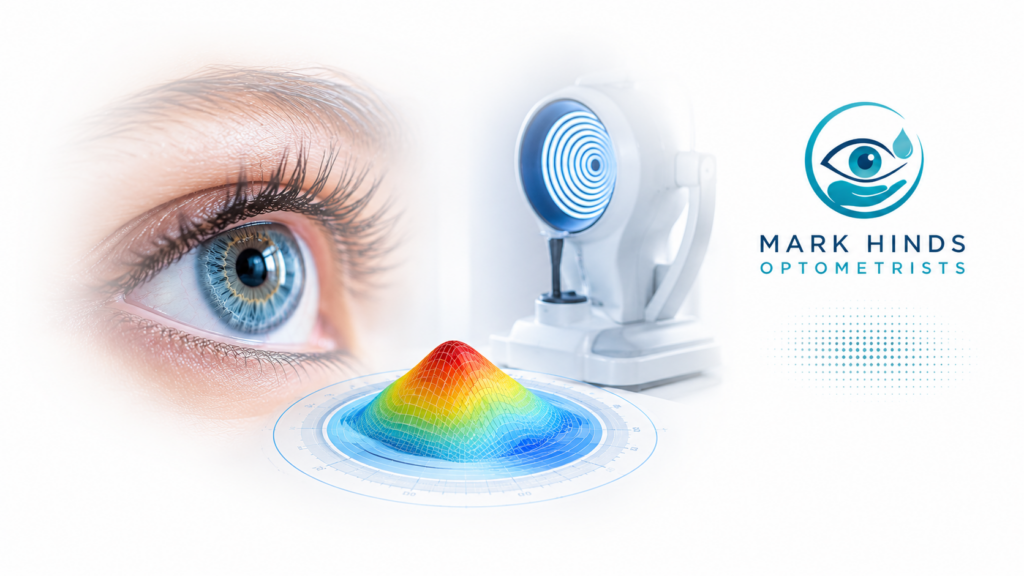
Keratoconus Symptoms and Signs
Keratoconus can be difficult to detect, because it comes on slowly. You may have distorted and blurred vision. You might also notice glare and light sensitivity. Keratoconic patients often have prescription changes each time they visit their optometrist. It’s not unusual to have a delayed diagnosis of keratoconus, if the practitioner is not familiar with the early-stage symptoms of the disease.
What Causes Keratoconus?
Causes of keratoconus are unclear. Managing the atopic component is often the first course of action and once this is done, we can see no progression. A genetic link may exist, as you may find several keratoconics within an extended family. We now have the ability to predict keratoconus progression with advanced screening techniques – read below!
Keratoconus Treatment
In the mildest form of keratoconus, spectacles or soft contact lenses may help. But as the disease progresses and the cornea thins and changes shape even more, spectacles or soft contacts will no longer correct your vision. We will work with you to find you the most effective and comfortable way of fixing your vision needs, even if you have failed in the past, we are more than happy to help.
Corneal Graft Contact Lens Care
Mark Hinds Optometrists is proud to provide highly specialised care for patients with corneal grafts, including one of the largest corneal graft contact lens patient groups in Australia. Mark presents to the post graduate course on post corneal graft contact lens considerations at the Australian College of Optometry in Melbourne, Australia.
Post-graft corneas require experience, precision and ongoing clinical support. Every graft is different. Shape, thickness, wound profile, corneal sensitivity, astigmatism, ocular surface health and long-term graft stability all need to be carefully considered before fitting a contact lens. Our team has extensive experience working with complex post-graft eyes and understands the balance between achieving excellent vision and protecting the long-term health of the graft.
We work closely with some of Australia’s most experienced corneal specialists, providing coordinated care for patients following penetrating keratoplasty, DALK, DSAEK, DMEK and other corneal procedures. This close collaboration allows us to support patients with complex corneal histories, irregular astigmatism, graft-host junction changes, ocular surface disease and high visual demands.
For suitable patients, we use advanced sMap 3D customised scleral contact lens technology. This allows detailed mapping of the eye so lenses can be individually designed to vault the graft, minimise bearing on vulnerable tissue and improve comfort, centration and vision. These lenses can be manufactured in highly oxygen-permeable materials to help support corneal physiology and reduce hypoxic stress.
Our goal is not simply to fit a lens. It is to provide a safe, stable and personalised visual rehabilitation pathway for each graft patient.
We also provide 24/7 support for our corneal graft patients, recognising that symptoms such as redness, pain, sudden vision change, light sensitivity or contact lens intolerance may require urgent advice.
At Mark Hinds Optometrists, corneal graft care is a major area of clinical focus. We are committed to protecting graft health, improving vision and supporting patients for the long term.
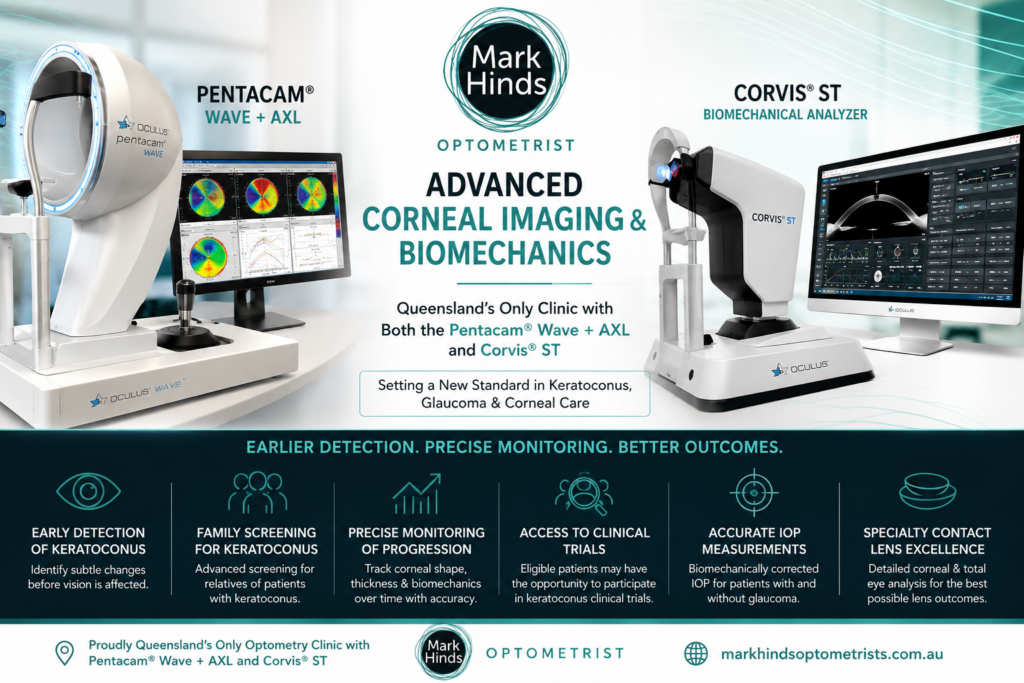
Queensland’s Only Clinic with Both the Pentacam® Wave + AXL and Corvis® ST
At Mark Hinds Optometrists, we are committed to bringing the most advanced technology in eye care to our patients. We are proud to be the only optometry clinic in Queensland with both the Pentacam Wave + AXL and the Corvis ST — two world-leading diagnostic systems that are transforming the way keratoconus, glaucoma, and complex corneal disease are detected and managed.
This combination of technology places our clinic at the forefront of modern corneal and glaucoma care, offering patients access to a level of diagnostic precision rarely available outside major research institutions.
Earlier Detection of Keratoconus
Keratoconus is a progressive condition where the cornea becomes thinner and weaker, leading to irregular vision and visual distortion. Detecting keratoconus early is critical — particularly before laser refractive surgery or before significant vision loss occurs.
Traditional eye examinations may miss very early or subtle disease.
The combination of the Pentacam Wave + AXL and Corvis ST allows us to assess:
- Corneal shape and elevation
- Corneal thickness progression
- Corneal biomechanics (how strong or weak the cornea is)
- Higher-order optical aberrations
- Early structural instability before obvious changes occur
Using advanced algorithms such as the Corvis Biomechanical Index (CBI) and Vinciguerra Screening Report, we can identify patients at risk of keratoconus earlier than ever before.
This is particularly important for:
- Young patients with changing prescriptions
- Patients with unexplained astigmatism
- Family members of patients with keratoconus
- Patients considering laser eye surgery
Screening Family Members for Keratoconus

Keratoconus often has a genetic component, meaning close family members may also be at risk.
At Mark Hinds Optometrists, we strongly encourage screening of:
- Siblings
- Children
- Parents of patients with keratoconus
Our advanced imaging technology allows us to detect subtle abnormalities long before vision deteriorates, helping preserve sight and allowing earlier intervention such as corneal cross-linking when appropriate.
Monitoring Progression with Exceptional Precision
Monitoring keratoconus progression is essential when deciding if interventions such as corneal cross-linking are required.
The Pentacam Wave + AXL provides highly repeatable tomography and axial length measurements, while the Corvis ST adds a crucial biomechanical assessment of corneal strength and stability.
This means we can monitor:
- Changes in corneal curvature
- Corneal thinning
- Biomechanical weakening
- Disease progression over time
This level of detail helps ensure treatment decisions are made at the right time — not too early and not too late.
Access to Keratoconus Clinical Trials
As part of our close integration with Ophthalmic Trials Australia, patients at our clinic may have the opportunity to participate in emerging clinical trials involving:
- New keratoconus therapies
- Advanced contact lens technologies
- Novel diagnostic systems
- Future corneal treatments
This provides eligible patients with potential access to cutting-edge treatments and technology not yet widely available.
More Accurate Eye Pressure Measurements for Glaucoma Care
Most eye pressure measurements are affected by corneal thickness and corneal biomechanics. This means standard pressure readings can sometimes overestimate or underestimate the true intraocular pressure (IOP).
The Corvis ST allows us to calculate biomechanically corrected IOP (bIOP), improving the accuracy of glaucoma assessment in patients:
- With thin corneas
- With keratoconus
- After laser refractive surgery
- With abnormal corneal biomechanics
- With ocular hypertension or glaucoma
This technology helps improve clinical decision-making and may reduce the risk of underdiagnosing or over-treating glaucoma.
Precision Contact Lens Care
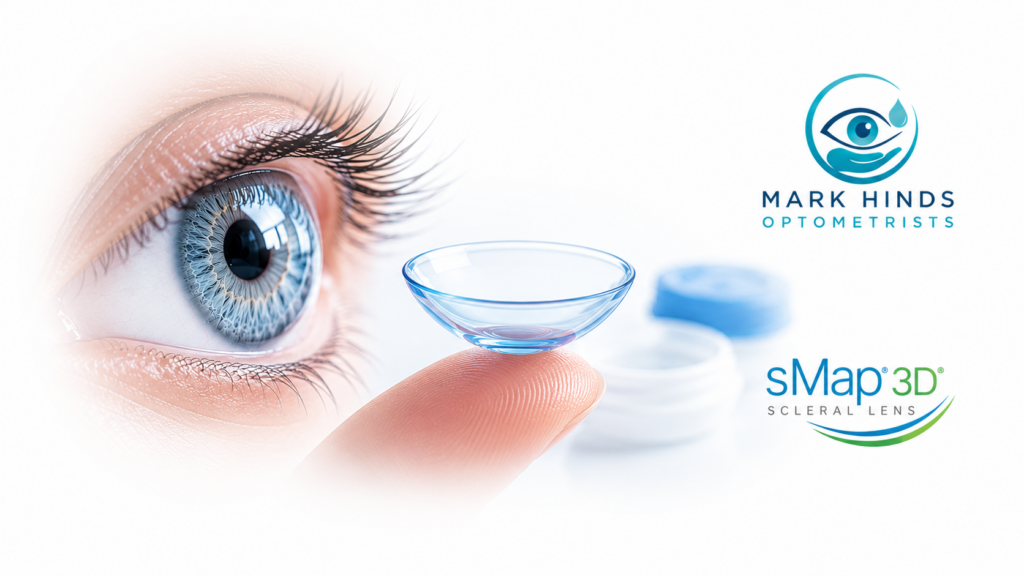
For patients requiring specialty contact lenses — including scleral lenses and keratoconus lens designs — the Pentacam Wave + AXL provides detailed corneal and total-eye optical analysis.
This allows us to:
- Better customise specialty lenses
- Assess optical quality over lenses
- Optimise vision outcomes
- Manage complex corneal conditions more effectively
Leading the Future of Eye Care in Queensland
At Mark Hinds Optometrists, we believe advanced technology should translate into better patient outcomes.
By combining the Pentacam Wave + AXL and Corvis ST, we are able to provide:
- Earlier diagnosis
- Better disease monitoring
- More precise glaucoma assessment
- Advanced specialty contact lens care
- Access to innovative clinical research
This unique technology platform helps position our clinic at the forefront of modern optometry and corneal care in Queensland.
For our downloadable PDF’s, click the link below:
Please see the videos below for any more information.
Cleaning your Scleral, Mini-Scleral, Corneo-Scleral and RGP Contact Lenses with BOSTON solutions.
Cleaning your Scleral, Mini-Scleral, Corneo-Scleral and RGP Contact Lenses with MENICARE solution.
Cleaning your Scleral, Mini-Scleral, Corneo-Scleral and RGP Contact Lenses with PEROXIDE solutions.
Cleaning your Scleral, Mini-Scleral, Corneo-Scleral and RGP Contact Lenses with BIOTRUE solution.