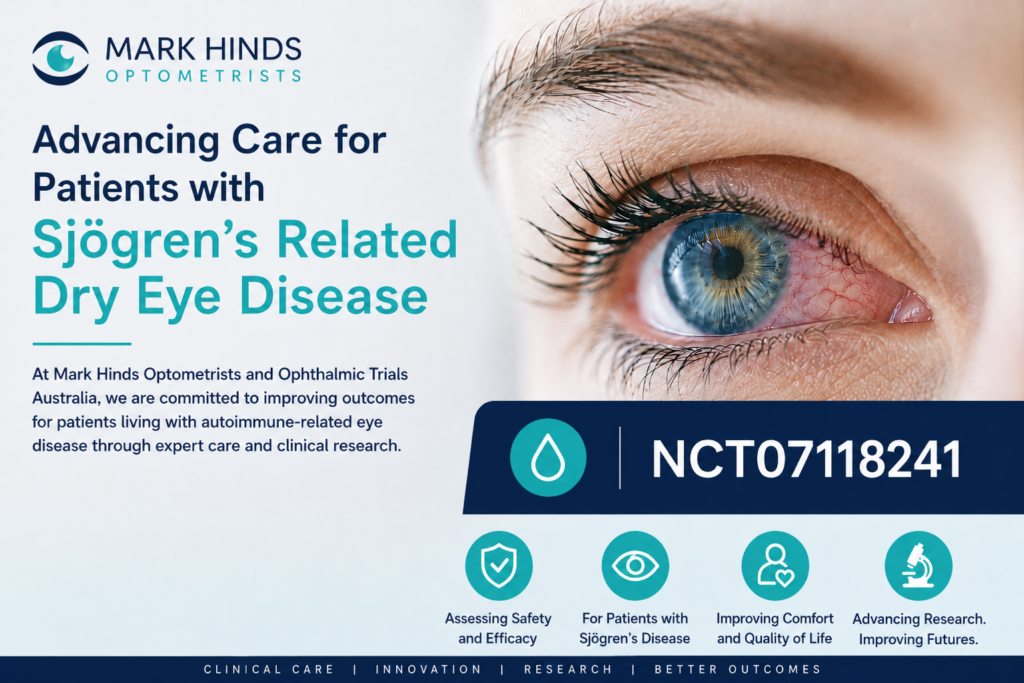
Our care and research:
At Mark Hinds Optometrists and Ophthalmic Trials Australia, our team is committed to improving the lives of patients living with severe dry eye disease, ocular surface inflammation, and autoimmune-related eye disease through advanced clinical care, research, and innovation.
One important area of focus is Sjögren’s related dry eye disease — a chronic autoimmune condition that can significantly affect the tear-producing glands and the ocular surface.
For many patients, Sjögren’s disease is far more than “dry eyes”. It may cause persistent dryness, burning, grittiness, fluctuating vision, light sensitivity, eye pain, fatigue, and reduced quality of life. In some patients, the ocular surface becomes inflamed and fragile, requiring careful monitoring and long-term management.
Our team is proud to be involved in clinical research aimed at finding better treatment options for patients living with Sjögren’s related dry eye disease.
What is Sjögren’s Related Dry Eye Disease?
Sjögren’s disease is an autoimmune condition in which the immune system can affect the body’s moisture-producing glands, including the lacrimal glands that help produce the tear film.
When tear production and tear quality are reduced, the surface of the eye may become unstable, inflamed, and uncomfortable. This can lead to symptoms such as:
- Persistent dryness
- Burning or stinging
- Foreign body sensation
- Light sensitivity
- Fluctuating or blurred vision
- Ocular surface inflammation
- Corneal staining or epithelial compromise
- Eye pain and discomfort
- Reduced tolerance to contact lenses or screen-based tasks
Managing Sjögren’s related dry eye disease is often complex. It may require a combination of advanced dry eye therapies, anti-inflammatory treatment, tear conservation strategies, ocular surface monitoring, and in some cases, specialty contact lenses such as scleral lenses.
At Mark Hinds Optometrists, we have a dedicated focus on advanced dry eye disease, ocular surface disease, corneal imaging, and complex contact lens care.
Clinical Research for Sjögren’s Related Dry Eye Disease — Open Now
Ophthalmic Trials Australia is currently involved in a clinical trial investigating a potential treatment option for patients with Sjögren’s related dry eye disease.
Sjögren’s Related Dry Eye Disease Trial — OPEN NOW
NCT07118241
Phase II — 28 Day Study
This is a prospective, randomised, vehicle-controlled Phase II clinical trial assessing the acute safety and efficacy of an investigational eye drop compared with vehicle in participants with Sjögren’s related dry eye disease.
The public trial registry describes the study as assessing rhPRG4 450 µg/mL recombinant human Proteoglycan 4 compared with vehicle for the treatment of Sjögren’s related dry eye disease. The study is being conducted in Australia and includes recruitment sites in Queensland, New South Wales, and Victoria.
The study aims to evaluate both safety and efficacy outcomes over a 28-day treatment period, including clinical signs such as corneal fluorescein staining and patient-reported symptoms including dryness, burning, stinging, pain, blurred vision, and photophobia.
Who May Be Suitable?
Potential participants may include adults with a confirmed diagnosis of Sjögren’s disease and chronic dry eye symptoms.
The public registry lists key inclusion criteria including participants aged 18 to 80 years, a diagnosis of Sjögren’s disease for at least three months, and current use of artificial tears as the only topical treatment for Sjögren’s related dry eye for at least 30 days before screening. Final eligibility is determined by the clinical trial protocol and study team.
This study may be relevant for patients who experience ongoing symptoms such as:
- Chronic dry eyes
- Burning, stinging, or grittiness
- Foreign body sensation
- Light sensitivity
- Fluctuating vision
- Persistent discomfort despite lubricant eye drops
Participation in a clinical trial is always voluntary, and all participants are assessed carefully to determine whether the study is appropriate and safe for them.
Why Research Matters
Sjögren’s related dry eye disease can be difficult to treat. While lubricants, anti-inflammatory therapies, eyelid treatments, punctal occlusion, and scleral lenses may help many patients, not everyone achieves adequate relief.
Clinical trials are essential for developing new treatment options and improving the future standard of care.
At Ophthalmic Trials Australia, our research program is focused on helping advance new therapies for patients living with complex ocular surface disease, including autoimmune dry eye conditions such as Sjögren’s disease.
The goal of this work is simple but important:
To help find therapies that improve comfort, reduce ocular surface damage, protect vision, and improve quality of life for patients living with Sjögren’s related dry eye disease.
Supporting Patients Beyond Research
Research is only one part of what we do.
At Mark Hinds Optometrists, we also provide ongoing clinical care for patients living with dry eye disease, Sjögren’s related ocular surface disease, and complex corneal conditions, including:
- Advanced dry eye assessment
- Tear film and ocular surface imaging
- Corneal staining and ocular surface monitoring
- Meibomian gland assessment
- Inflammatory dry eye management
- IPL and advanced dry eye therapies
- Scleral contact lenses for severe ocular surface disease
- Collaborative care with ophthalmologists, rheumatologists, and other medical specialists
We understand that autoimmune dry eye disease can be persistent, frustrating, and life-changing. Our mission is to combine evidence-based clinical care with high-quality clinical research to help improve outcomes for patients now and into the future.
Interested in Learning More?
If you have Sjögren’s disease and ongoing dry eye symptoms, you may be suitable for further assessment.
To learn more about current clinical trials at Ophthalmic Trials Australia or to register your interest, please contact our team.
Clinical trial participation is subject to screening criteria and study eligibility. The investigational product is not approved for general clinical use for this indication, and participation does not guarantee clinical benefit.