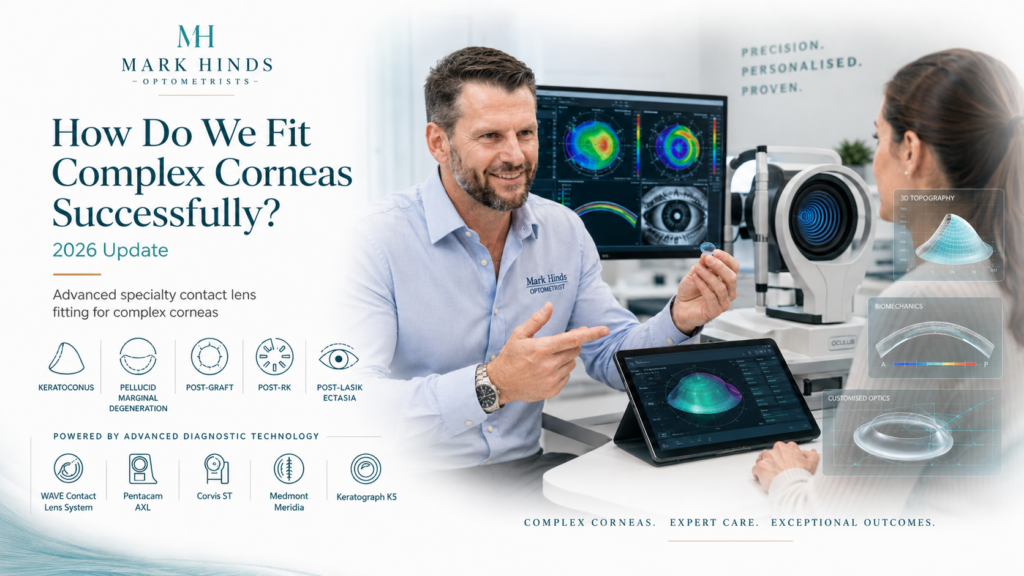
After fitting thousands of eyes with complex contact lenses, we continue to lead the way in 2026. What began years ago with free-form 3D contact lens design has grown into one of the most comprehensively equipped specialty contact lens practices in the country. The result is simple: even the most difficult corneas — keratoconus, pellucid marginal degeneration, post-graft, post-RK, post-LASIK ectasia and severely irregular surfaces — can be fitted with stable, hyper-oxygen-permeable lenses and customised front-surface optics down to the hundredth of a dioptre.
Why measurement is everything
A complex lens is only ever as good as the data it’s built on. The more accurately we map the cornea, the sclera and the optics of the eye, the better the lens fits, the more comfortable it is, and the sharper the vision. That’s why we have invested in a suite of diagnostic technology that few practices anywhere can match — and why we use several instruments together on the one eye rather than relying on a single map.
Our specialty fitting workflow now draws on:
sMap 3D Contact Lens System — free-form, fully customised gas-permeable and scleral lens design, letting us build a lens to the individual eye rather than forcing the eye into a stock lens.
Pentacam AXL — Scheimpflug tomography giving complete front and back corneal elevation, pachymetry mapping and axial length in a single capture.
Corvis ST — corneal biomechanical analysis and accurate IOP, invaluable for detecting and monitoring keratoconus and ectasia and for understanding how each cornea behaves.
Medmont Meridia and Keratograph K5 (5M) — high-resolution corneal topography, plus detailed tear film and ocular surface assessment so we manage comfort and dry eye alongside the fit.
Anterior Segment OCT Imaging — high-resolution cross-sectional imaging of the cornea, scleral lens and post-lens tear reservoir. This allows us to assess lens clearance, vault, landing, edge alignment, corneal shape and tear reservoir thickness with far greater precision, particularly in complex scleral lens and post-graft fittings.
Combining biomechanics, full tomography, anterior segment OCT and dual-topographer data means we design from a true 3D picture of the eye — not an educated guess.
Why we’re sent the hard cases
This depth of imaging, paired with decades of specialty fitting experience, is why other optometrists and ophthalmologists refer their most complex contact lens patients to us, and why patients travel long distances — often from interstate and regional Queensland — to be seen. When a fit has failed elsewhere, the answer is almost always better data and more options. We have both.
If you, or a patient you care for, have a cornea that’s been called “too hard to fit,” we’d welcome the opportunity to help.
Book online today or call. We are happy to help.