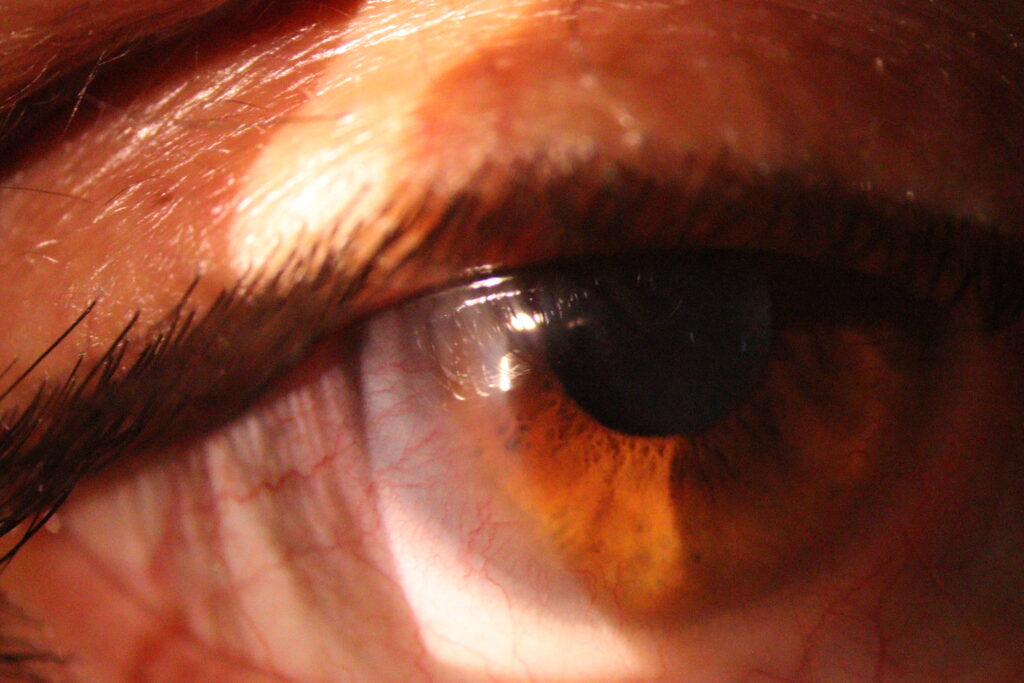
Right eye of a patient showing significant corneal neovascularisation.
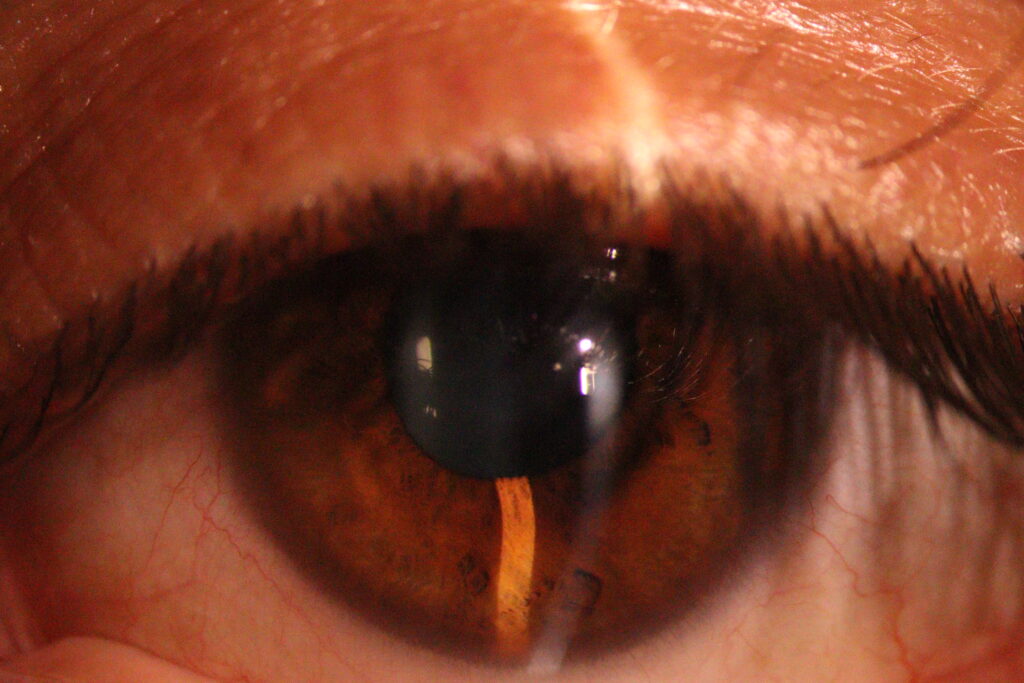
Left eye of the same patient, without comparable corneal neovascularisation.
Corneal neovascularisation refers to the growth of new blood vessels into the cornea. The cornea is normally clear and largely avascular, which is one of the reasons it can transmit light so effectively. When blood vessels begin to grow into the cornea, it is usually a sign that the eye has been exposed to chronic stress, inflammation, hypoxia, mechanical irritation, or a combination of these factors. Contact lens wear is one recognised contributor, particularly when oxygen delivery to the cornea is compromised.
The images above are a useful clinical comparison. They show the same patient, with the right eye demonstrating significant corneal neovascularisation, while the left eye does not show the same vascular response. This type of asymmetry is important because it reminds us that scleral contact lens fitting is not simply about placing a lens on the eye. It is about managing the entire oxygen system of the cornea, the lens, and the post-lens tear reservoir.
Why scleral lenses are different
Scleral contact lenses are often life-changing for patients with advanced keratoconus, corneal irregularity, ocular surface disease, and complex corneal conditions. Unlike a standard soft contact lens, a scleral lens vaults over the cornea and lands on the sclera. This creates a fluid reservoir between the back surface of the lens and the front surface of the cornea.
That reservoir is one of the reasons scleral lenses work so well. It can neutralise irregular astigmatism, protect the ocular surface, and provide a smoother optical surface for vision. However, the same reservoir also changes the way oxygen reaches the cornea.
Oxygen must pass through multiple layers: the lens material, the physical thickness of the lens, the post-lens tear film, and then into the cornea. Research on scleral lens oxygen transmissibility describes this as a “resistors in series” problem: each layer contributes resistance, and the total system matters more than any one component alone.
The weakest link: the post-lens tear reservoir
Modern high-Dk scleral lens materials have significantly improved oxygen delivery compared with older materials. In our practice, we use Acuity 200 material in appropriate cases because it is an ultra-high oxygen permeable GP material, listed by Acuity Polymers as having a Dk of 200.
That matters. A high-Dk material helps reduce the oxygen resistance created by the lens itself. However, in advanced and extreme keratoconus, the lens material is not always the main limitation. The post-lens tear reservoir can become the weakest link.
This is particularly relevant when there is marked corneal steepening, decentration, or a highly asymmetric cone. In these eyes, the relationship between the optic zone, transition zone, and corneal apex becomes challenging. The lens must still vault the cornea safely, but where the optic zone and transition zone meet, there may be a large or unavoidable tear reservoir. That extra fluid thickness increases the distance oxygen must travel before it reaches the cornea.
Even with an excellent high-Dk material, a thick tear reservoir can still reduce oxygen availability. Clinical research has shown that lower-Dk scleral lenses can produce greater corneal swelling than higher-Dk lenses, but even with higher-Dk materials, corneal oedema is still associated with fluid reservoir depth.
Why this matters in extreme keratoconus
In mild to moderate keratoconus, it is often possible to design a scleral lens with a controlled fluid reservoir and good corneal clearance. In extreme keratoconus, the lens design problem becomes more complex.
The lens must avoid corneal touch, especially over the cone. It must align with the sclera. It must maintain stability. It must deliver acceptable optics. It must avoid excessive limbal compression. And it must do all of this while maintaining enough oxygen delivery for long-term corneal health.
That is a delicate balance.
In some patients, a large tear reservoir may be created not because the lens is poorly fitted, but because the corneal shape is so extreme that a safer mechanical vault requires extra clearance in certain zones. The clinical skill is in identifying where that clearance is necessary, where it can be reduced, and whether the oxygen burden is becoming unacceptable.
What we look for clinically
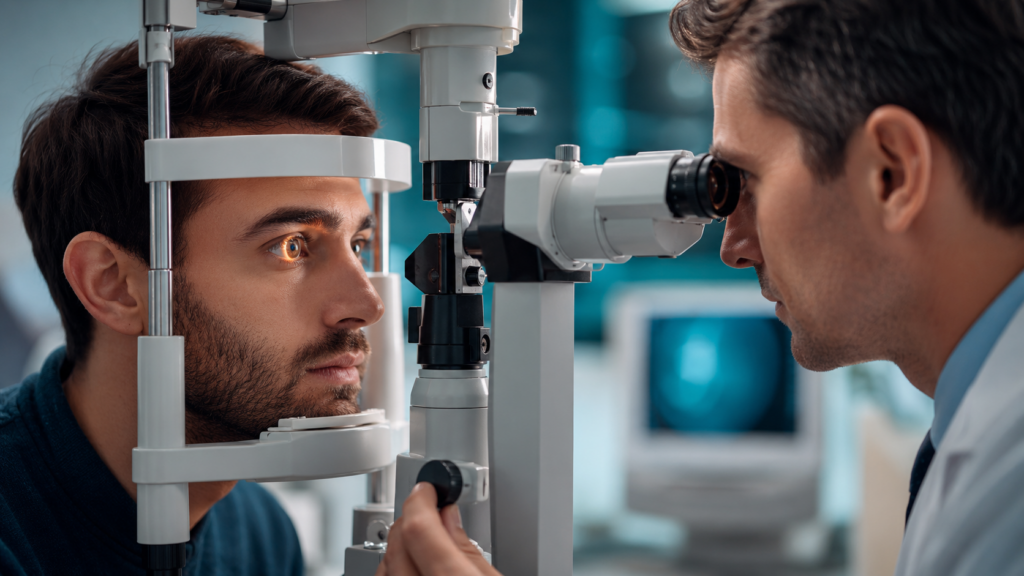
When monitoring scleral lens patients, especially those with advanced keratoconus, we look carefully for signs of oxygen stress and vascular change. These include:
- new or progressive corneal neovascularisation
- limbal redness or compression
- corneal oedema or microcystic change
- excessive post-lens tear reservoir thickness
- conjunctival blanching from tight landing zones
- reduced wearing tolerance
- inflammatory change or recurrent surface irritation
A good scleral lens fit is not judged only by comfort or vision. A patient may see well and feel comfortable while still showing signs that the cornea is not receiving ideal oxygen delivery.
How we manage the risk
The aim is not simply to “fit a scleral lens”. The aim is to fit a scleral lens that provides vision, comfort, ocular surface protection, and long-term corneal physiology.
In cases where oxygen delivery is a concern, we may consider:
- Using the highest practical oxygen-permeable material, such as Acuity 200 where appropriate.
- Reducing unnecessary lens thickness while maintaining stability and optical quality.
- Minimising excessive post-lens tear reservoir thickness, particularly centrally and near the limbus.
- Refining the transition zone to avoid unnecessary vault where the corneal shape allows it.
- Improving scleral landing alignment to reduce compression, blanching, and conjunctival congestion.
- Reviewing the lens after settling, because clearance can change substantially after hours of wear.
- Monitoring with slit-lamp imaging, anterior segment OCT, corneal topography/tomography, and clinical photography.
- Adjusting wearing time if corneal physiology is being compromised.
- Co-managing with ophthalmology where corneal neovascularisation is progressive, deep, visually significant, or associated with other pathology.
The key message
Scleral lenses remain one of the most powerful tools we have for managing advanced keratoconus and complex corneal disease. However, they must be fitted with a detailed understanding of oxygen delivery.
High-Dk materials such as Acuity 200 help reduce one part of the oxygen problem. But in extreme keratoconus, the major limitation may be the post-lens tear film, especially where the corneal shape forces a significant tear reservoir around the optic-zone and transition-zone relationship.
The two eyes shown here demonstrate why each eye must be assessed individually. The same patient can show very different corneal vascular responses between eyes. That difference is clinically meaningful, and it is exactly why advanced scleral lens care requires careful design, high-quality imaging, and ongoing monitoring.
At Mark Hinds Optometrists, our approach is to preserve vision while protecting the long-term health of the cornea. In complex keratoconus, the best lens is not simply the lens that gives the clearest vision on day one. It is the lens that balances optics, comfort, corneal clearance, oxygen delivery, and long-term ocular safety.